
Alone in the Void [Part 4]: Trail Crest and the Final Summit Push (Day II)
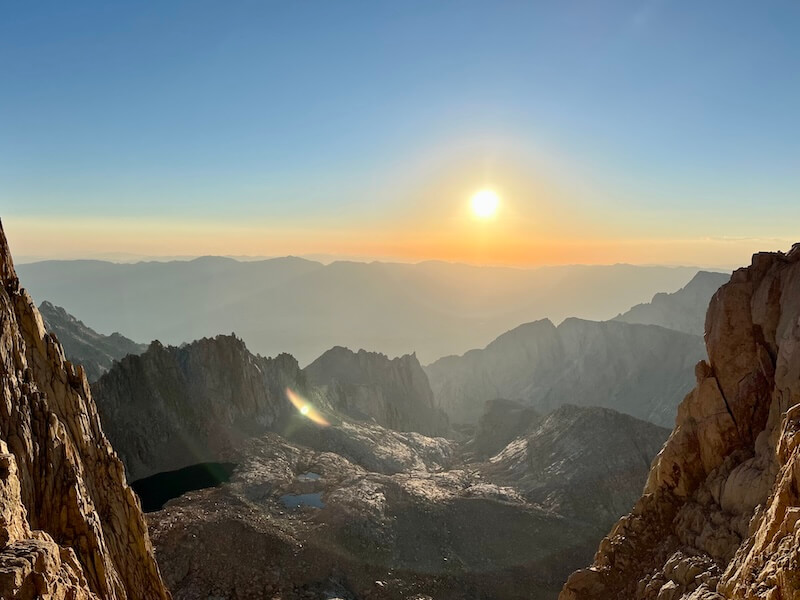
“For the first time, the summit no longer feels like an abstract destination—not just a goal I’ve trained for, but something real and within reach… The final push feels inevitable now.”
~ On the edge of the final climb
Table of Contents
5:50 AM – Trail Crest (13,645 feet): Highest Mountain Pass in the Contiguous US
Finally, after 2.2 miles, over 1,600 feet of elevation gain, and completing all 99 switchbacks, I make it to Trail Crest. A wave of accomplishment washes over me—this time, I’ve made it past the point that turned me back on my last attempt. Though it’s not fully daylight yet, the views are starting to unfold, revealing expansive vistas both to the east and west. The Mount Whitney elevation at Trail Crest marks a major milestone, sitting at 13,645 feet—it signifies the highest mountain pass in the lower 48 United States.
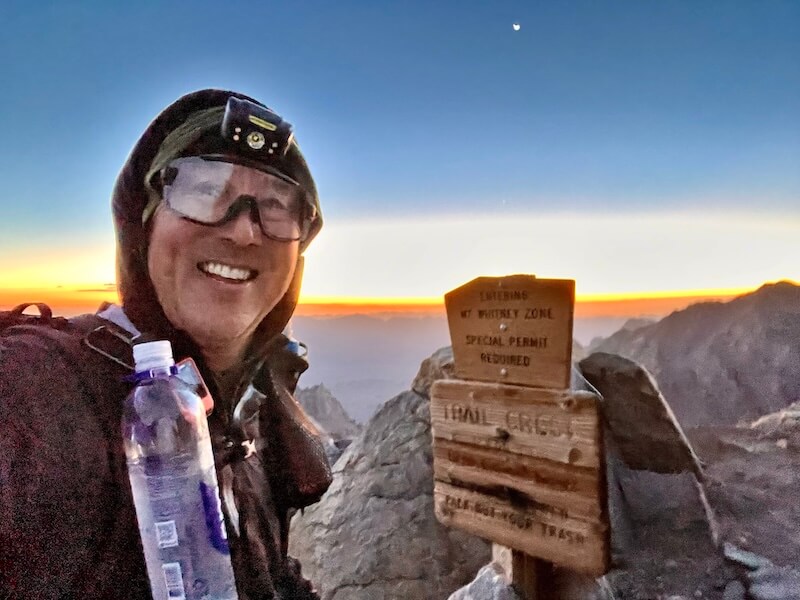
Behind me, the outlines of the Inyo National Forest mountains emerge in the dim light, with the arid Owens Valley stretching out 10,000 feet below like a vast desert expanse. On the opposite side of the ridge, the landscape transforms entirely. It feels like I’ve stepped into an alien world, where the terrain is a rugged mosaic of pale granite, shimmering in muted tones of beige, tan, and silver under the early morning light.
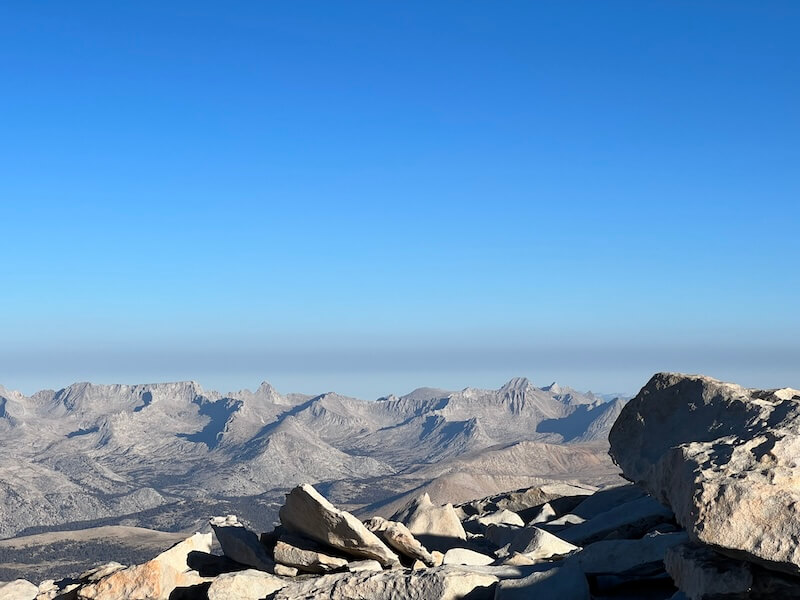
The mountainous texture to the west is striking. Nearby, the peaks are jagged and sharp, their brittle, crumbling granite freshly carved by the elements. It’s as if the mountains are alive, constantly reshaping themselves under the forces that created them. I’m fortunate—or perhaps humbled—to witness a distant rockslide on a peak flanking Guitar Lake, 2,000 feet below. It’s the second rockslide I’ve seen on this trip, a powerful reminder that this landscape is as dynamic and ever-changing as I am.
Farther out, the granite softens into what appear to be gentle, rolling giants, their once-sharp features smoothed by centuries of relentless wind, snow, and rain. These distant peaks tell a different story—one of time, patience, and endurance. The contrast between the jagged, freshly broken rock nearby and the ancient, weather-worn hills in the distance feels like a snapshot of geological history. It reveals the story of these mountains—their violent formation, gradual erosion, and the unceasing passage of time that shaped them and continues to do so.
As I stand here, taking in the contrast between the freshly carved granite and the softened peaks in the distance, it strikes me how much these mountains are like me—constantly shaped by the forces acting upon them. The process is slow, sometimes violent, but the changes are inevitable. Just like the lessons learned from each climb, we, like the mountains, continue to evolve.
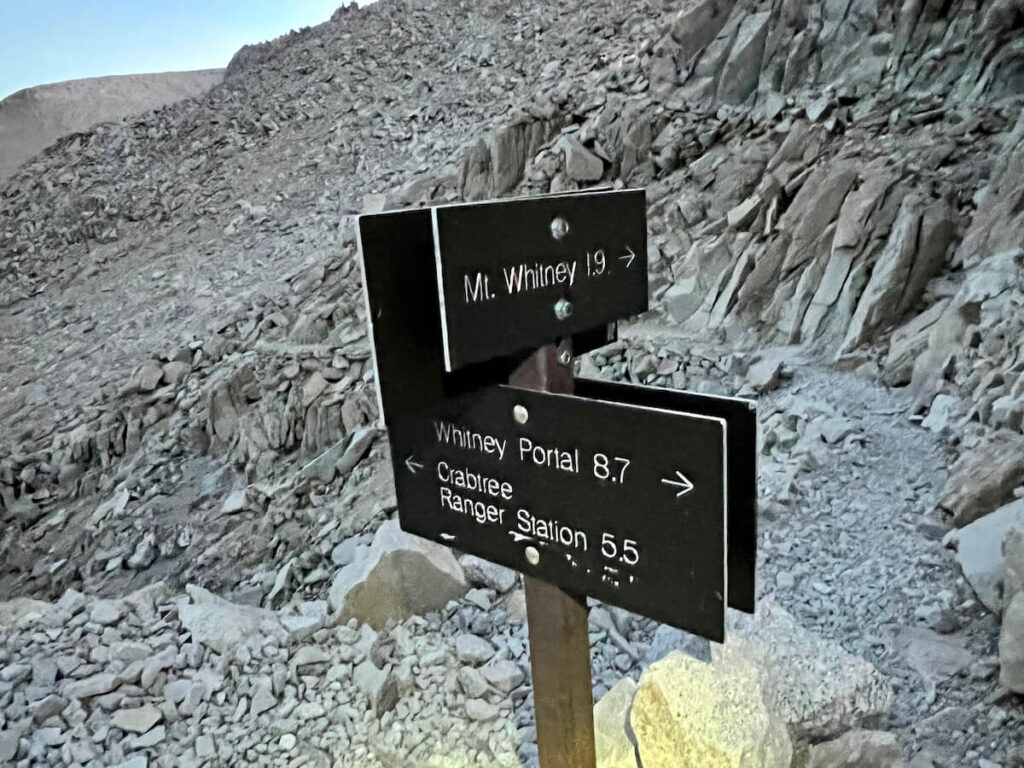
Onward. Time to turn my focus to the summit. After refueling with a stroopwafel (cookies and cream, a welcome treat) and replenishing my electrolytes, I press on. Interestingly—and a bit maddening—you actually descend a couple hundred feet over less than a quarter mile before reaching the junction with the John Muir Trail, which leads down to Crabtree Meadows to the west. This descent feels frustrating, knowing I’ll have to regain that altitude to reach the summit. But it’s all part of the journey, so I push forward, my sights set on the final stretch.
One thing becomes immediately clear—the trail from here feels more exposed, and the drop-offs are far steeper than before. Each step requires focus and sure footing, with the sheer cliffs adding a sense of urgency to every movement.
🛡️ BE PREPARED: Mountaineering Conditions
In snowy or icy conditions, this section can become treacherous, with catastrophic consequences for a misstep. Attempting this in winter or icy conditions requires advanced mountaineering skills, including proficiency with ice axes, crampons, microspikes (when appropriate), and self-arrest techniques. If you’re not confident in your abilities, consider taking a mountaineering course and thoroughly researching conditions before attempting this section in winter conditions. Safety is always paramount on the mountain.
6:20 AM - Splitting the Rock Towers
One of the most memorable moments of the ascent was when I approached and passed between two massive rock towers—distinct from the more well-known “Windows” further along the trail. These towering formations feel like a natural gateway, marking the start of the final summit push. As I walked beneath them, I caught my first glimpse of the summit block in the distance, and if you look carefully, you can even spot the Whitney Summit Shelter perched at the top.
It’s at this moment, standing between these imposing towers, that the possibility—no, the probability—of reaching the summit truly becomes tangible. After all the grueling switchbacks and long miles behind me, seeing that distant summit block fills me with renewed energy. For the first time, the summit no longer feels like an abstract destination—not just a goal I’ve trained for, but something real and within reach. I can see it now, sparking a sense of excitement and anticipation for what’s to come. My focus sharpens, and any lingering fatigue falls away as adrenaline kicks in. The final push feels inevitable now, not just driven by my body’s endurance, but by the sheer determination to stand at the top. It’s as if the summit itself is pulling me forward, and each step brings me closer to the moment I’ve been working toward for so long.
6:40 AM – Peak Baggers’ Paradise
The trail takes me on a traverse along the western side of the ridge, flanked by jagged, sawtooth peaks to my immediate right (east). Some of these peaks, also towering above 14,000 feet, present ambitious peak baggers with additional “side quests.” Mount Muir (14,018 feet) is perhaps the most popular of these, lying just off the main trail. It involves a Class 3 scramble near the top, making it a tempting challenge for those comfortable with rock climbing and scrambling.
Other peaks, like Keeler Needle (14,260 feet), Day Needle (14,175 feet), and Crooks Peak (14,080 feet), are considered even more technical. These Class 4 and 5 climbs require advanced mountaineering skills, including the use of ropes, proper equipment, and significant experience. DO NOT attempt these side quests unless you are fully prepared and experienced!
🛡️ BE PREPARED: Cliffed Out
Route finding also poses a significant challenge on these peaks, and mistakes can have serious consequences. One of the greatest risks is becoming "cliffed out," where you reach an impassable cliff or steep drop, leaving no safe way forward or back. The deceptive terrain can easily lead to dangerous situations, so it's essential to have both a strong understanding of the route and the experience to adapt if things don't go as planned.
Peeks Through Windows
*This video of the view through one of the “windows” was taken on the way down from the summit.
Between this magnificent series of peaks, the trail passes through the iconic “Windows”—natural gaps in the ridge that offer breathtaking views to the east. From these vantage points, you can peer through the steep drop-offs and see the vast expanse of Owens Valley and Lone Pine, sitting 10,000 feet below. It’s a humbling, awe-inspiring experience to stand at the edge and witness the valley stretching out beneath you—a sheer drop into the desert landscape.
On the way, I passed a few hikers returning from the summit—people I had chatted with the night before at Trail Camp. I had originally planned to start around 4 AM, but after they mentioned they were leaving at 3 AM, I decided to adjust my plans and set out earlier than anticipated. Thanking them for the helpful advice, they cheered me on, offering words of encouragement that gave me the extra boost of energy I needed to push on toward the summit.
Moments like these remind me that while summiting can feel like a solitary endeavor, the shared camaraderie on the trail is what truly enriches the experience. It’s not just about reaching the top—it’s the support, the encouragement, and the connections we build along the way that make each step feel lighter.
7:30 AM – Final Push: Hooking to the North and False Summits
So close, yet it still seemed so far—the final push to the summit. Around 7:30 AM, about four hours into today’s ascent, I veered right and hooked north, convinced I was on the last stretch. But then reality hit—it was a false summit. Even though I had read about it beforehand, that moment still carried a sting of disappointment. This twist is common for Whitney climbers, a final curveball the mountain throws your way.
As I pressed onward, the Smithsonian Institution Shelter, built in 1909 as a refuge for scientists and hikers, came into view on my left. While it’s not meant as a survival shelter—except in the most extreme cases—it serves as a perfect spot to pause, take in the view, and sign the summit registry. Leaning against its stone walls, I felt the weight of the journey and a surge of gratitude.
📖 DEFINITION: False Summit
A false summit is one of those cruel tricks the mountain plays on you when you think you're finally nearing the top, only to realize that the real summit is still lurking somewhere beyond. Just when you’re mentally ready to celebrate and take in the views, the trail says, “Not so fast.” False summits are all about keeping your expectations in check, because remember, the journey isn’t really over (or even half over) until your feet are parked on the actual top and your legs are questioning all your life choices.
Conclusion: The Summit in Sight
As I passed between the towering rock formations and finally caught sight of the summit, a surge of energy washed over me. After all the grueling switchbacks and hours of effort, the summit felt not just possible—but inevitable. With the final push ahead, my focus sharpened and the fatigue melted away. But as I near the top, I can’t help but wonder—what will it feel like to stand at the highest point in the contiguous U.S.? And will the descent be just as challenging as the climb?