
Alone in the Void [Part 3] – Last-Minute Preparations, Reflections, and My Previous Attempt [Day II]
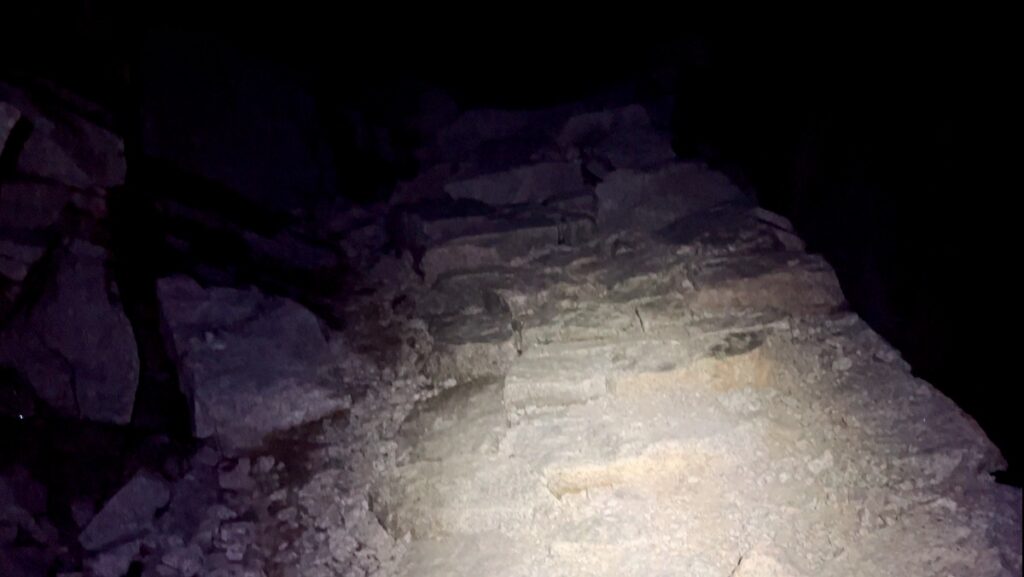
“Now, halfway up the infamous 99 switchbacks, in pitch-black darkness with only my headlamp illuminating the narrow trail ahead, I methodically place one foot in front of the other. Alone in the void of black space, all I have are my thoughts and the moon to keep me company. ”
~ Somewhere in the mountain’s shadow
Table of Contents
Day 2: The Ascent
Fueling Up, Securing Camp, and Facing the Alpine Challenges
On most backpacking trips, I like to heat up some water and enjoy oatmeal and coffee for a more relaxing breakfast. But today is different. Even though I’m not feeling particularly hungry—altitude often causes a loss of appetite—I manage to choke down two strawberry-frosted Pop-Tarts, some Liquid IV (electrolytes), and water. The Trail Camp Tarn is the last reliable water source for the next 10 miles, until you return here on your descent. Occasionally, you might find water from snowmelt along the 99 switchbacks, but this becomes less reliable as summer progresses.
Since I brought a single-person ultralight trekking pole tent, I need to collapse it and take my trekking poles with me before leaving camp. Marmots are notorious for tearing into tents searching for food, so I gently lay rocks on my tent to try and deter these curious critters. Marmots associate tents with potential food sources—often due to lingering smells or past encounters with careless campers. I emphasize “gently” because I once punctured a small hole in my tent’s roof by setting a rock on it, which allowed water to seep in—nothing that some Tenacious Tape couldn’t fix. If you have a traditional freestanding tent, it’s a good idea to leave a door unzipped so a curious marmot can enter and exit without causing damage. Yesterday, one of the other backpackers told me that while sitting inside his tent, a marmot boldly poked its head in, unafraid and searching for food.
Lastly, I make sure the tent is securely anchored with stakes and rocks. Every year, tents are blown off the mountain because they weren’t properly secured. With one final gear check, I’m ready to begin the ascent.
Trail Camp to Trail Crest at 13,645 feet (2.2 miles with 1,700 feet of vertical gain)
3:20 AM - 99 Switchbacks - Into the Void
On my last summit attempt in late May, during the shoulder season, I waited at Trail Camp until first light, unwilling to take on the exposure of climbing the partially snow- and ice-covered switchbacks in the dark. Although technically open according to the rangers, they were still treacherous in certain pockets. It’s a sobering fact that hikers have regularly lost their lives attempting the switchbacks in full winter conditions. Adjacent to the switchbacks, on the climber’s right, is the snow slope, which in full winter conditions is the only viable route and requires full mountaineering gear and experience. That experience taught me the importance of timing and safety. Now, in late August, the trail is completely free of snow and ice, making the ascent far more straightforward. This influenced my decision to start early today, ensuring I could tackle the trickier sections with confidence and clarity.
With the trail clear of snow and ice, I began my hike at 3:20 AM, getting an alpine start ahead of almost all the backpackers at Trail Camp and likely all the day hikers starting from Whitney Portal. The trail leading away from Trail Camp was easy to follow, beginning with a gentle grade. Just several hundred yards from camp, I hit my first switchback—here we go.
As I ascend higher, each switchback requires careful footing. I take my time, deliberately placing my feet and trekking poles on stable terrain, staying closer to the mountain to avoid the steep drop. Even though Trail Camp had been quiet and still when I left, I knew others were present, each preparing to face their own internal challenge. I felt a deep sense of connection and community there. But with every step further up and away, that feeling of connectedness quickly fades.
Now, halfway up the infamous 99 switchbacks, in pitch-black darkness with only my headlamp illuminating the narrow trail ahead, I methodically place one foot in front of the other. Alone in the void of black space, all I have are my thoughts and the moon to keep me company. The dominating thought in my mind is that I alone am responsible for my safety. Every step, every pole plant must be focused and deliberate. A momentary lapse in concentration could have unknown consequences. While I wouldn’t characterize the summer trail on Whitney as “dangerous,” several factors—fatigue, altitude sickness (AMS), hypoxia, dehydration, dizziness, or hitting the wall due to lack of calories—can all subtly impact the safety of the trail.
The ascent feels paradoxical. Though I’m physically climbing hundreds of feet higher, the thinning air and darkness create an unsettling sense that I’m descending deeper into an abyss, further removed from humanity. With each step, a growing sense of loneliness creeps in, pulling me downward, despite my upward movement.
Emerging from the Void: Finding Clarity in the Darkness
As I continue to ascend, switchback by switchback, my thoughts begin to shift. At first, each step is intentional, accompanied by a slight unease as I move deeper into the void. I have to admit, moments of fear creep in. As someone prone to overthinking, the pitch-blackness feels almost claustrophobic. Despite knowing I’m exposed two and a half miles above sea level, it feels as if I’m enclosed in a bubble of impenetrable darkness. But I force myself to focus on the next immediate goal—the next switchback, the rocks just a few feet ahead, the next step and pole plant. Slowly, like emerging from a heavy fog, those feelings begin to fade. With every switchback I ascend, it feels like breaking free from a thick veil, leaving behind a renewed sense of purpose.
As I reach each successive switchback, the oppressive darkness begins to lift. With it, the weight on my mind dissipates, and the path ahead becomes clearer. With every step, I feel lighter and more focused. It’s in this moment—both physically and metaphorically—that I realize this journey is more than just a climb; it’s a reflection of the summits we all face in life.
❤️4U
This brings me back to the core purpose of One More Summit. Alongside trip reports and gear reviews, OMS exists to help you discover and conquer your own personal summits, whether they’re the physical peaks you ascend or the internal challenges you confront. Just like me in this moment, you too can push through the darkness and reach your own summit. You are appreciated, you are capable, and nothing can stop you from achieving what lies ahead. Together, we’ll push boundaries and celebrate each step forward.
4:30 AM – The Cables: Halfway to Trail Crest (~12,800 feet)
Between the 45th and 46th switchbacks lies a long stretch of trail carved into solid rock, bordered by the iconic cables. Installed in the early 1900s to assist hikers through this treacherous section, the cables’ current usefulness is mostly symbolic. Over the years, heavy snow accumulation has bent the final sections of poles and cables so far away from the trail’s edge that they now offer little to no safety—particularly in winter and shoulder seasons, when snow and ice can completely obscure the trail.
This last cables section, along with several rock-scrambling areas required to ascend the switchbacks, proved especially tricky during my previous summit attempt. At that time, the snow and ice rendered many switchback turns impassable. The challenge of navigating those precarious, snow-covered sections in a ‘no-fall zone,’ while already fatigued from the climb, ultimately led me to turn back.
Over time, I’ve come to realize that trail conditions exist on a continuum—ranging from impassable to wide open, overgrown to well-maintained, or damaged by rock slides and floods. There are also varying degrees of risk tolerance, particularly with technical scrambling. Trail reports come from all types of hikers, from rangers and seasoned experts to those with varying levels of skill and risk comfort. Finding where you fit on that continuum is something that only comes with experience.
Looking back, my decision to turn back that day was difficult, but it reinforced something I’ve come to value on every climb: knowing when to push forward and when to retreat. Experience has taught me that not every summit is worth risking your safety. In the end, it’s not about conquering the mountain—it’s about recognizing your limits and respecting the conditions that can shift at any moment. This understanding has made me a stronger, more prepared climber, and it’s something I carry with me on every ascent.
What keeps me grounded and ensures I make sound decisions in these difficult moments is a laminated photo of my two children, taken when they were young. It’s a reminder that the mountain will always be there, but if I make a poor decision, I may not. This becomes especially crucial in group settings, where my choice may cause the entire team to turn back, or when suffering from altitude sickness (AMS), which clouds judgment. The ability to turn back isn’t a sign of weakness—it’s a mark of maturity and wisdom as a backpacker.
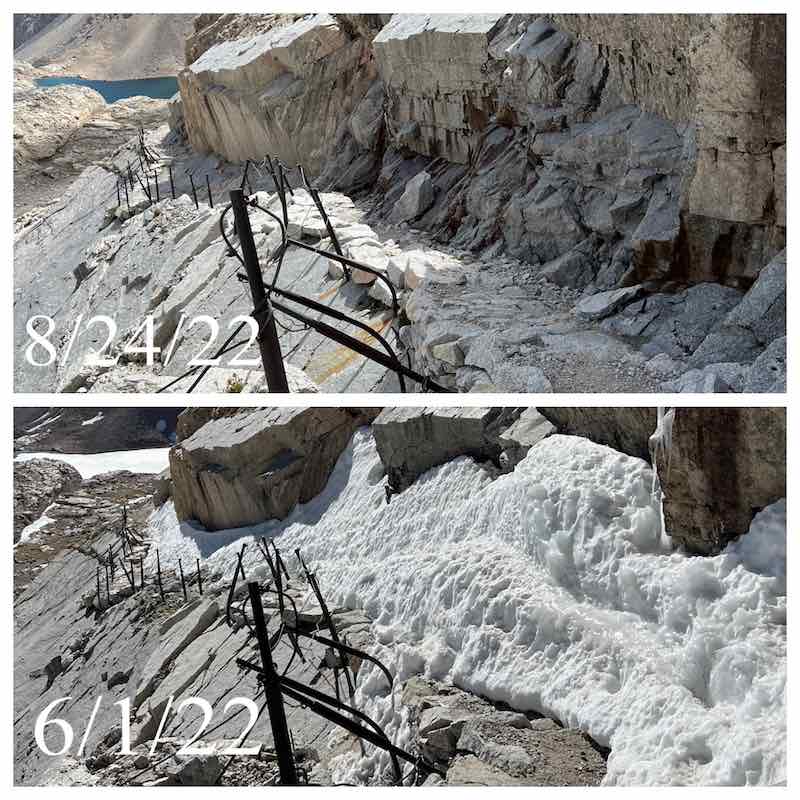
This time, with no snow in sight, I trekked through without encountering any obstacles. This stretch of trail, marked by the cables, constitutes the longest straight section before reaching the final set of switchbacks leading to Trail Crest. As I continue ascending, I begin to notice that the pitch-black darkness isn’t as overwhelming. I look down and spot a pinprick of light—another hiker’s headlamp, slowly making its way up the switchbacks below me. After a few more switchbacks, the hiker catches up and is now behind me.
Pausing for a much-needed break, I take a few deep breaths and sip on some electrolytes. I instinctively shield my headlamp with my hand, careful not to blind the fellow hiker as he passes. We exchange a quick hello and words of encouragement, a small but powerful reminder of the camaraderie shared among hikers on challenging trails like this. In these moments, it’s clear that we must look out for and support each other.
5:35 AM – Approaching Trail Crest: Emerging from the Darkness
One of the most rewarding aspects of hiking is when I enter a state of flow—a rare, meditative rhythm where everything aligns perfectly. Back when I was a competitive swimmer, we called it “being in the zone.” It’s that out-of-body experience where your technique is flawless, your body moves on autopilot, and fatigue fades into the background. It feels as if your mind and body have synced seamlessly with the world around you. This was the sensation that began to wash over me on the trail.
Though I was in a state of flow, a sense of heightened awareness lingered at the edges of my focus. I was fully conscious of the stakes—up here, a single misstep could have serious consequences. The trail demanded respect, even in my most meditative state.
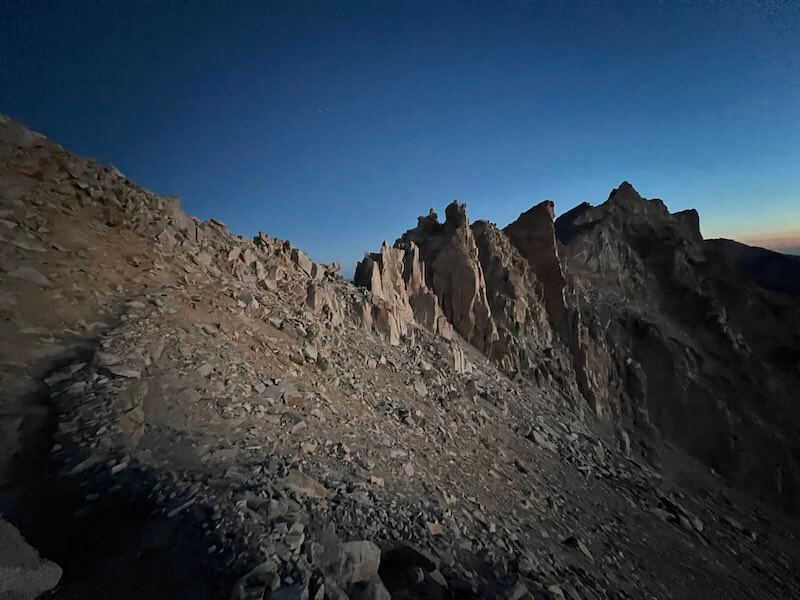
With each passing minute, the darkness didn’t fade—it simply grew less absolute. Slowly, the world around me began to reveal itself, as though the veil of night was being lifted inch by inch. The trail, once shrouded in near-complete blackness, started to unfold ahead of me, its rocky contours becoming clearer with every step. It was subtle at first, but then, like an expanding bubble, the shadows seemed to retreat, offering more detail, more clarity with each moment.
The towering peaks that had been hidden in the night began to emerge as faint silhouettes against the sky. The rough rocks beneath my feet sharpened into focus, and I could feel the anticipation building as daybreak approached. The pressure of light slowly pushed against the dark horizon. Yet, I was still wrapped in the solitude of the early morning, enveloped by the mountain’s shadow. There was something undeniably special about this gradual transition, as if the mountain itself was revealing its secrets with each step in the stillness.
💡 JEFF’S INSIGHTS: Path to Clarity
This moment mirrored so much of the challenges we face in life. Clarity doesn’t always arrive in a flash; sometimes it’s a slow unveiling, like the mountain revealing itself as the night recedes. Patience and persistence—both on the trail and in life—are what allow us to push through the darkness. The key is to stay focused, even when progress feels subtle, and trust that with every step, we are getting closer to our goals. Just as the light slowly replaced the shadows, the path forward often becomes clearer only after we’ve moved beyond our doubts and fears.
Conclusion: Onward to Trail Crest
With every step up the switchbacks, I feel the weight of the mountain pushing back, yet the pull of the summit grows stronger. The darkness around me slowly gives way to the faintest hints of dawn, and the trail becomes clearer with each passing moment. I pause, catching my breath, knowing that the hardest part of the ascent still lies ahead. But with the anticipation of reaching Trail Crest—the highest mountain pass in the lower 48—fueling my determination, I push on. Will Trail Crest live up to its legendary status? And how will the final push toward the summit unfold?